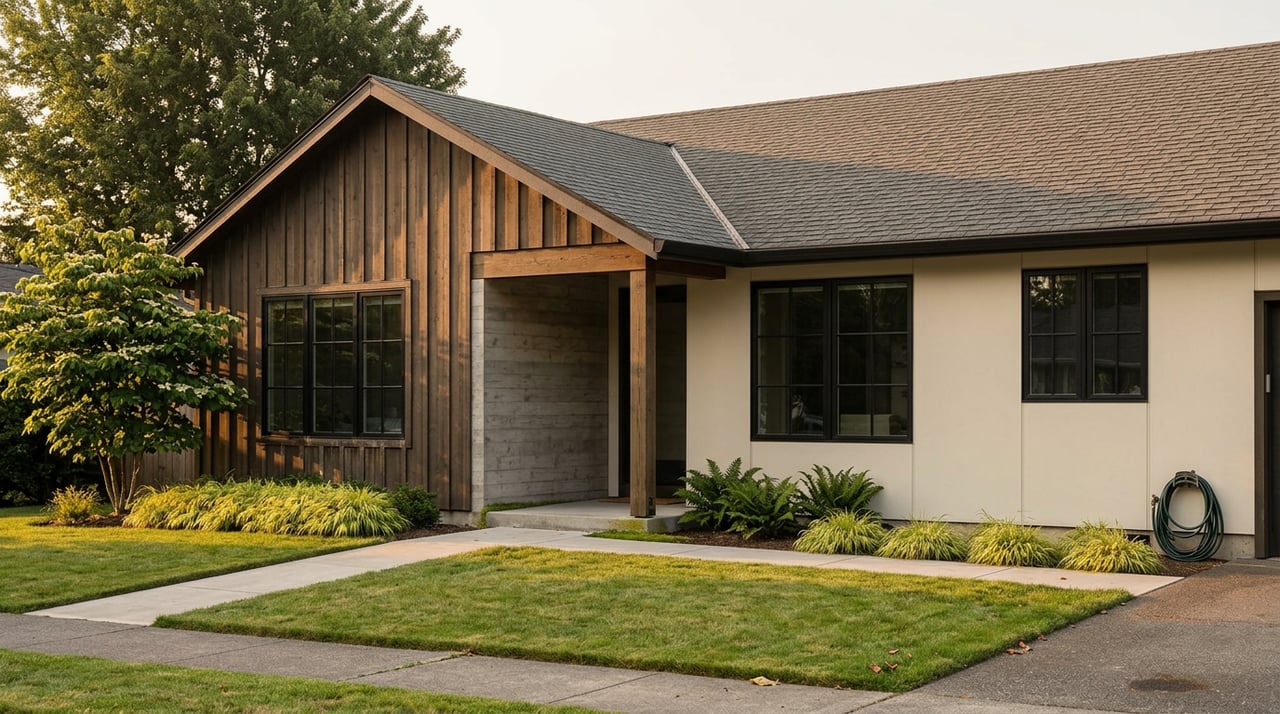
Two three-bedroom homes can sit four blocks apart in north Kennydale. One is zoned to Renton schools. The other, despite the matching zip code and nearly identical lot size, is zoned to Bellevue schools. Nothing on the listing photos tells you which is which. The only way to know is to run the exact address through a boundary map before you write an offer, because the difference shows up later, at resale, when one home carries a school-district premium the other never will.
That's the kind of detail a median price can't hold. And Renton's median price is currently holding a lot it shouldn't. In the three months ending May 2026, homes across the city sold for a median of $712,000, down 1.8 percent from the same window a year earlier. That single number gets repeated on every portal search and every "Renton housing market" roundup, and it is technically accurate. It is also close to useless for anyone trying to figure out what they will actually pay, because Renton isn't one market with some noise around the edges. It's four or five markets that happen to share a city limit, moving at different speeds, some of them in opposite directions at the same time.
Four Renton's, One Zip Code
Pull the city apart by neighborhood and the picture stops looking like a bell curve and starts looking like four separate conversations.
| Area | Typical single-family range | What defines it |
|---|---|---|
| Kennydale | $700,000 to $1.2 million-plus | Lake Washington waterfront and hillside lots, limited new construction, the premium micro-market |
| Downtown / Cascade / Renton Hill | Lower base, fastest recent appreciation | Redevelopment around The Landing and South 3rd Street pushing prices up from historically modest levels |
| Renton Highlands | $500,000 to $700,000 | The plateau east of downtown, the largest inventory pool, the mainstream family tier |
| Fairwood / Benson Hill | $550,000 to $850,000 | Established and newer suburban subdivisions to the south and east, larger lots |
Kennydale alone tells you why a citywide average is the wrong tool. Sales there over the trailing twelve months carried a median price around $1,457,500, up roughly 21 percent from the prior twelve-month period, with homes moving in about 35 days against a national average closer to 53. That's not a Renton number. That's a Lake Washington waterfront number that happens to have a Renton mailing address.
The Contradiction Hiding in Central Renton
Here's where it gets interesting, and where a lot of "market update" content stops looking too closely because the numbers don't fit a clean headline.
In the three months ending May 2026, homes in the neighborhood Redfin classifies as Central Renton sold for a median of $525,000, down 19.9 percent from the same period a year earlier. Read on its own, that looks like a submarket in free fall. But in that same window, the median price per square foot in Central Renton actually rose 8.3 percent year over year. Two numbers, same neighborhood, same three months, moving in opposite directions.
That isn't a contradiction once you look at what actually sold. Only 17 homes closed in Central Renton in May 2026, up slightly from 16 the year before. With a sample that small, the median price is extremely sensitive to what kind of home happened to sell that month, not how much the neighborhood is worth. If the mix shifts toward smaller condos and townhomes and away from larger detached houses, the median sale price drops even while the actual value per square foot climbs. The neighborhood isn't cheaper. The mix of what sold in it changed. That distinction matters enormously if you're pricing a listing or sizing up a purchase, because reacting to the median without checking the mix means either underpricing a home you're selling or assuming a discount that was never really there.
East Renton Highlands: The Same Trap, Running the Other Way
The Highlands area shows the mirror image. In February 2026, East Renton Highlands homes sold for a median of $987,000, up 11.8 percent year over year. On its own, that reads as a hot submarket. But the average days on market in that same period was 61, compared to 18 days a year earlier. Homes are taking more than three times as long to sell while the median price climbs.
That combination usually means one of two things is happening: either buyers are getting pickier and only the strongest, most expensive listings are closing while the rest sit, or the volume of sales has thinned out enough that a handful of high-end transactions are dragging the median upward without reflecting the market most buyers actually experience. Either way, "prices are up 11.8 percent" is true and misleading at the same time. A neighborhood where sales are slowing down while the median rises is not the same story as a neighborhood where genuine demand is pushing every price point higher.
Meanwhile, the older core Highlands area, which Redfin tracks as a distinct pocket from the newer East Renton Highlands subdivisions further out, has been telling a different story in its own recent reporting: an average house price around $620,000, down about 9 percent year over year, with homes moving faster, in roughly 30 days. Same plateau, same general geography, different trend entirely. This is the whole thesis in miniature. Even "the Highlands" isn't one market.
Why Downtown and Cascade Are Catching Up From Behind
The strongest year-over-year price gains in Renton right now belong to the neighborhoods with the lowest starting point: downtown, Cascade, and Renton Hill. That's not a coincidence. It's a direct response to what's been built and planned there over the past year or two:
- The Landing's retail and dining district and newer townhome inventory near Gene Coulon Memorial Beach Park have added the kind of urban amenity Renton didn't have a decade ago.
- Streetscape investment along South 3rd Street is turning downtown from a commuter pass-through into somewhere people actually walk.
- The city's Benson Hill Community Plan update in May 2026 specifically called out Cascade Village as a redevelopment target, with planners acknowledging that no new development has landed there yet despite years of discussion, which tells you the opportunity is still ahead of the price, not behind it.
- The King County I-Line Bus Rapid Transit route, expected to begin service in 2027, will connect the Renton Transit Station directly to the Auburn Transit Station through Benson Hill, adding transit access to a corridor that currently has very little.
None of that guarantees continued appreciation. It does explain why a neighborhood starting from a lower price base is seeing the fastest percentage gains in the city. Employment is doing its own quiet work here too. The Boeing Renton plant and Valley Medical Center remain the city's two largest anchor employers, and that mix of aerospace and healthcare jobs keeps a broad, steady pool of buyers shopping across every one of these submarkets at once rather than concentrating demand in just one.
The Boundary Nobody Puts on the Listing
Which brings the conversation back to where it started. Renton's neighborhood boundaries don't always match its school district boundaries, and the gap between the two can be worth real money at resale.
North Kennydale addresses can fall inside the Bellevue School District rather than Renton's, depending on the exact parcel. A similar split exists in Fairwood, where some homes are zoned to the Kent School District instead of Renton. None of this shows up in a neighborhood name or a listing headline. It shows up when you run the specific address through the Renton School District's boundary map or the equivalent tool for a neighboring district, and it's worth doing before you fall for a house, not after your offer is already in.
What This Means If You're Comparing Renton to Kent or Bellevue
Renton's whole value proposition rests on sitting between two other markets: meaningfully cheaper than Bellevue, where the broader Eastside median sold price reached $1,449,975 in February 2026, and somewhat more expensive than Kent, where typical single-family homes run $500,000 to $600,000. That positioning holds at the city level. It does not hold inside Renton itself, where Kennydale already competes with Bellevue's price tier and parts of Central Renton and the Highlands trade closer to Kent's.
The same split shows up in rents. As of June 2026, the citywide average apartment rent in Renton sits around $2,137 a month, but that average is bracketed by Kennydale at $2,669 and Downtown Renton at $2,396 on the high end, and the Cedar River, Highlands, and Valley pockets running $1,829 to $1,940 on the low end. If you're comparing "Renton rent" to "Bellevue rent" or "Kent rent" as single numbers, you're comparing an average that's already splitting apart internally to another city's average that may or may not be splitting the same way.
The Question Worth Asking Instead of the Median
The useful question isn't "what's Renton's median home price." It's "which Renton am I actually looking at." Kennydale, downtown and Cascade, the Highlands, and Fairwood and Benson Hill are four different pricing conversations, four different pace-of-sale patterns, and in some cases four different school districts hiding inside neighborhoods that look uniform from a portal search. A median price averages all of that into a number nobody's house actually sells for.
Is Renton a buyer's or a seller's market right now? It depends on which submarket. Kennydale and the redeveloping downtown corridor are behaving like seller's markets with fast sales and rising prices. Central Renton's small sample size and the Highlands' longer time on market look more balanced, leaning toward buyers who are willing to negotiate on the right property.
Which Renton neighborhoods are appreciating fastest right now? Downtown, Cascade, and Renton Hill are showing the strongest year-over-year gains, though from a lower starting price than Kennydale or the broader Highlands.
How do I check school district assignment before I make an offer? Run the exact parcel address through the Renton School District's boundary map rather than relying on the neighborhood name, since boundaries in north Kennydale and parts of Fairwood cross into Bellevue and Kent districts respectively.
If you're weighing a purchase, a sale, or an investment property anywhere between Kennydale and the Highlands, the median won't tell you what you need to know, but a conversation about your specific block will. AMP Properties Group NW tracks these submarkets neighborhood by neighborhood across the Puget Sound. Reach out for an instant home valuation or a straight answer on what your budget actually buys in Renton right now.
